

The NC500
Five hundred miles of single-track roads, white beaches and sea lochs, looped out of Inverness. Give it a week and take it slowly.
The North Coast 500 is the trip people mean when they say road trip. Five hundred miles of single-track roads, white-sand beaches and sea lochs, looped out of Inverness and back again. We run it anticlockwise: the gentle east coast to ease you in, the wild west coast saved for last.
Give it a week. The joy is in the stopping: a flask of tea above an empty bay, a detour up a glen, a night parked where the only sound is the sea. Fenyx suits this one, with room to stand and cook while the weather does whatever it likes outside.
Quiet spots are easy to find, and the heater earns its keep when the evenings turn. Bring the dog, bring a good map, and let the road set the pace.
A shape for the days.
Inverness and the Black Isle
Pick up in Inverness, provision at the big shops while you still can, and cross the Kessock Bridge onto the Black Isle. It eases you in with gentle farmland, a brewery, and dolphins off Chanonry Point if the tide is right. Then the road turns north up the quiet east coast.
- Chanonry Point dolphins an hour either side of high tide
- Provisioning stop, the last big supermarkets before the north
- A first night close to the water
OvernightRosemarkie, above the firth
Up the east coast to Dunbeath
North along the easy east coast, where the miles come gently. Dornoch has a beach and a cathedral in miniature, and Dunrobin Castle looks borrowed from the Loire, with falconry on the lawn most afternoons. A relaxed day before the roads turn wild.
- Dunrobin Castle and its falconry
- Dornoch beach and its golf-town charm
- The gentle run up to Dunbeath
OvernightDunbeath, on the cliff road
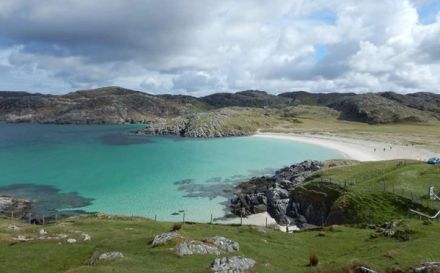
01Intended shot · Achmelvich Bay, northwest Highlands of Scotland John o' Groats and the top corner
Up past Whaligoe to the top-right corner of the country. Skip the signpost photo at John o' Groats and walk out to Duncansby Stacks instead, the better spectacle, then on to Dunnet Head, the true most northerly point on the mainland. From here the road runs west along the top, empty and wide.
- Whaligoe Steps down to the old herring haven, if your knees agree
- Duncansby Stacks sea pillars
- Dunnet Head, the true most northerly point
OvernightDunnet Bay, facing the Pentland Firth
02Intended shot · Fenyx on the Bealach na Bà hairpins, the Inner Sound and Skye behind Durness and the far north
West to Durness, where the north coast saves its best. Smoo Cave sits right under the village, Balnakeil has a chocolate maker in an old radar station, and Sango Bay is the sort of beach that makes you forget the drive. From here the road turns south down the west coast.
- Smoo Cave, a torch helps
- Balnakeil craft village and beach
- Ceannabeinne beach, often empty
OvernightDurness, above Sango Bay
Assynt and the far north west
South into Assynt, where the landscape goes ancient, single mountains standing alone on the moor. Lochinver makes a good lunch stop, famous for its pies, and Achmelvich is the white-sand cove that ends up on the postcards.
- Suilven and Stac Pollaidh from the road
- Lochinver pies, worth the queue
- A swim at Achmelvich if you are brave
OvernightClachtoll, on the machair
03Intended shot · the white sand at Achmelvich, campervan parked back on the machair Torridon, Gairloch and Applecross
Down through Ullapool and under the Torridon giants, red sandstone mountains that make the campervan feel very small. Gairloch earns a stop for its beaches and otters, then the coast road runs on to Applecross. A pint by the water at the Applecross Inn, with a view over to Raasay and Skye, is a fine place to spend the last night.
- Loch Torridon viewpoints under Liathach
- Big Sand beach at Gairloch
- The Applecross Inn, seafood and a pint by the bay
OvernightApplecross bay
04Intended shot · Sango Bay from the dunes at dusk, side door open and the kettle on The Bealach na Bà and home
Save the best road for last. Climb out of Applecross over the Bealach na Bà, the great switchback pass and the highest road climb in Britain, with respect and second gear. From the summit it is an easy run down to Inverness, the loop closed and the last morning unhurried.
- The Bealach na Bà hairpins, Britain's highest road climb
- Wester Ross falling away behind you
- The last easy miles into Inverness
OvernightInverness, ready for the morning drop-off
Before you go
- Mileage
- About 516 miles for the loop itself, plus your run to Inverness
- Fuel
- Fill up in Inverness before you leave. Fuel thins out on the north and west coasts, so top up when you pass Thurso and Ullapool; pumps are scarce around Lochinver.
- Ferries and tolls
- None on the classic loop; the Kessock Bridge is free
- Best months
- May, June and September, for long light and quieter single tracks
We decided to brave a camper-van experience to do the NC500 in Scotland. We were a bit nervous at first to say the least but TC Campers were excellent. From the first enquiry, to picking up the van and through to final drop off the experience was first rate. Maria provided us with lots of information on the route itself which was invaluable in our adventure planning. The camper was well equipped to give us the confidence to set off on our first camping trip in 30 years. We were reassured by the fact that the team at TC Campers were at the end of the phone should we need them. The welcome pack was a really nice touch and helped get us started on the journey. The van itself was amazing to drive, easy to park and coped with the narrow scottish roads with ease. We had an amazing adventure and the van gave us the freedom to complete the NC500 in our own time. We loved being able to sit and watch the world go by with a cup-a-soup in hand soaking up the scenery. A few of the campsites we used over looked beaches meaning we were able to wake up next to a beautiful view, which is something we both will remember for a long time. We really enjoyed the whole experience and hope to book another adventure with TC Campers soon.
Ready for The NC500?
A week in Fenyx suits this one, with off-grid heating for cold northern nights and room to stand and cook while the weather does its thing.